It isn’t just W.L. Gore who has a very unique management structure. This morning I received Adaptive Path’s Newsletter, and in it is an article explaining their own management structure or Advocate Program. It’s very interesting and I couldn’t help relate it to W.L. Gore’s structure. I’ve pasted the article below but for context first read Peter Merholz brief summary and then come back here.
P.S. If you want the article leave me your email in the comments or DM me on Twitter and I’ll forward it to you.
In the beginning
The Advocacy Program started in 2006 when Adaptive Path was about 16 people big. As we grew, an ad-hoc management structure began to emerge, and it started to look and feel like a traditional reporting structure. As an entrepreneurial and egalitarian culture, that didn’t seem to be a good fit for us. Janice Fraser in her role as CEO introduced a different approach: a 1:1 support structure we called the Advocate Program.
The Advocate Program is a communication system designed to support and empower all employees. The role of the Advocate is to support, guide, push and to advocate for your success. Every person at Adaptive Path has an Advocate, and each Advocate/Advocatee relationship is unique to its members; this is part of what makes the program so special.
Adaptive Path was founded on principles of personal responsibility, creativity, curiosity, mutual respect, self-determination, a healthy tolerance for ambiguity and a collective commitment to design that delivers great experiences that improve people’s lives. Having this foundation of shared values was an important starting point for a program that relies so heavily on interdependency.
Contributing factors are in play, of course. The Advocate Program isn’t the only organizing structure we have. The nature of the work we do (consulting, our public events, R&D) is very project-centric, and project teams define their own working practices. We have different lines of business that organize tasks and responsibilities for their work. We have smaller groups that focus on fostering ideas and thinking about UX approaches and methods. We also have multiple studios and the Studio Directors coordinate work in each location. We have a running-the-business group that herds all the cats. But for overall people-support, the Advocate Program is the glue.
Overall, the structure of Adaptive Path looks less like this:

And more like this:
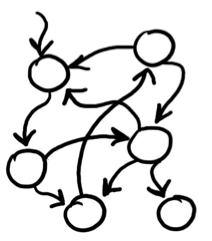
The program in a nutshell
The basics:
- Everyone has an Advocate.
- Advocatees ask someone (anyone) to be their Advocate, and the partnership is confirmed by mutual agreement.
- People can change their Advocacy relationship at any time, for any reason. This is true for both the Advocatee and the Advocate.
- No closed loops; you can’t be the Advocate for someone who is Advocating for you.
- Advocates generally have no more than three Advocatees.
What do Advocates do?
- Advocates do lots of the things that in a traditional business would be done by a manager:
- Help set goals, give feedback, find inspiration and move you beyond your comfort zone.
- Help you cope and deal with issues and act as an escalation point if needed.
- Coordinate feedback, reviews and goal-setting with the people to whom you’re accountable.
From a tactical standpoint:
- Advocates and Advocatees meet at least once a month for a check-in, but many pairs meet more often.
- Advocatees work with their Advocate to set direction/goals for the year.
- Advocates gather ongoing feedback for their Advocatees.
- A listing of Advocatee/Advocate relationships is available on an internal wiki, so that everyone knows who’s with whom, and who they can go to with feedback or issues.
A good Advocate…
Like a mentor, a good Advocate is someone absolutely credible whose integrity transcends the message, be it positive or negative. They tell you things that may be hard to hear, but in a way that leaves you feeling you have been heard. An Advocate interacts with you in a way that makes you want to become better—better designer, worker, person—and makes you feel secure enough to take risks.
A good Advocate gives you confidence to rise above your own doubts and fears and supports your attempts to set stretch goals for yourself. They also identify opportunities and highlight challenges you might not have seen on your own. And on a more day-to-day level, they can help you get things done. In a previous newsletter, my colleague Pam wrote about doing some goal mapping with her Advocatee while her own Advocate helped document the process so Pam could share it in the newsletter thus fulfilling one of her own goals to write more. This is just one example of the kinds of advocacy activities happening at any given moment within Adaptive Path.
How do people choose their Advocates?
Reasons for choosing an Advocate are personal and unique to each staff member. Some common reasons that people have mentioned include:
“I chose my Advocate because he is doing the kind of work that I want to do.”
“I chose my Advocate because I trust her to tell me the honest truth…even if it’s hard to hear.”
“I chose my Advocate because she is willing to go to bat for me…and sometimes I need a kick in the butt.”
“I chose my Advocate because he’s been around and has Adaptive Path company history.”
It’s recommended that you choose an Advocate you think you can learn from, someone who has succeeded in an area you, too, want to be successful. You can choose an Advocate who does entirely different work than you, who can expose you to something new or to a different way of thinking about or approaching your work. Some of our non-practitioners, for example, find it really helpful to team up with designers to bring a little of that old sticky-note, whiteboard ‘magic’ into the way they tackle things.
Many people at Adaptive Path have held management roles in the past: they’ve led others, run teams, departments, businesses, and have coached or mentored people both formally and informally. That said, the most important qualities for an Advocate to possess are honesty, thoughtfulness and a strong desire to help their Advocatees be as successful as possible—in whatever form success takes for each person.
How has it evolved?
As we’ve grown, we’ve made some changes to help the program adapt and scale.
In 2009, we formed the Advocate Council to support the Advocate program. The Council has four members: two roles specifically for people-related functions which are Director of HR and the First Advocate. The First Advocate helps all our new hires get into the groove and find their way as an Adaptive Path newbie. The other members are selected annually by the whole company. The goal is for the selection process to be as lightweight as possible: a call goes out to fill the open seats, and a short web survey is provided for staff to select the names of people they think would be a good fit for the role. The new members are welcomed in at a company meeting.
Picking an Advocate is a personal choice, and it means you have to know who people are so that you can find a good match. With 50+ employees, that’s a lot to ask for new folks, so now there is a First Advocate who serves the role for the first three months. During this time the First Advocate encourages you to meet new people, go out to coffee or work on a project with specific co-workers, and overall helps you get socialized into the Adaptive Path culture. After three months, you’re ready to talk to potential Advocates and make an informed choice.
Once a year the Advocate Council hosts Advocacy Open Enrollment, which (like a health plan) is a designated time to refresh and renew Advocate relationships. This may mean finding a new Advocate, or it may mean renewing a current relationship—whatever is best for each employee.
There aren’t a bunch of forms to fill out or a lot of red tape. The process is designed so that nothing gets in the way of open and personal conversations between people. These conversations are key to making a good match. And a $5 coffee card given to each employee helps grease the skids for the conversations. Additionally, each person who wants to be an Advocate creates an Advocacy Profile outlining their approach to Advocacy which we post on our internal wiki to be browsed by those looking to make an Advocate/Advocatee match.
The Advocate Trophy (a bronzed unicorn—long story) is awarded quarterly to an Advocate (nominated by their Advocatee) who has gone above and beyond in supporting their Advocatee. This is a way to see what kinds of support are helpful and appreciated, and is a way to acknowledge great support models and techniques.
But wait. Isn’t this really complicated and time-consuming?
Yep. One thing we know for sure it that it’s more complicated than a traditional command and control structure. But the purpose is less about maximizing organizational efficiencies and more about supporting overall individual and collective effectiveness and creating space for people to do their best work no matter what their role is within the organization. The process relies on a level of self-awareness and self-knowledge that is important in fostering true collaboration and creative progress. The culture at Adaptive Path demands that people are intentional about charting their own course and having the internal motivation to realize their best work. This is hard, but the rewards and personal fulfillment that result make it worth the investment.
Although the specifics have evolved, the underlying principles that were the inspiration for the program are still fundamental:
- Mutual respect and trust in each other
- An honest desire to see every individual succeed
- Manage the work, not the people
- Support personal growth and inspire people to move out of their comfort zone
- Celebrate trying new things
- Honest, frank conversations
- Be a good company citizen
It’s a challenge to scale a flat(ish) organization, and the models for coordination and collective leadership are not as well known as the business-as-hierarchy approach. But Adaptive Path is not in the business of running trains or manufacturing hard goods. We’re a design company where the challenges are wicked, the focus is on people and the speed of change is rapid. The 1:1 support model means that we rely on each other to do our best work. The Advocate Program was designed to enable this to happen. To quote Janice Fraser, “The best work happens when we are all smarter for having worked together.”
What’s next?
As Adaptive Path continues to grow, we’ll have to revisit how the Advocate Program can scale, especially across three studios. Perhaps in the future it will transform into something very different. But the underlying principles of investing in each other and supporting the team are fundamental to being the kind of company we want to be.
Other companies that we watch and learn from also have the strong commitment to employee support and people-centric programs. Pixar, Netflix, Southwest Airlines, Zappos…all are known for their strong internal cultures and their focus on making an environment where individuals can participate fully and realize their full potential. These companies are also known for incredible customer loyalty and strong financial performance.
That’s a model we’re happy to work with.



