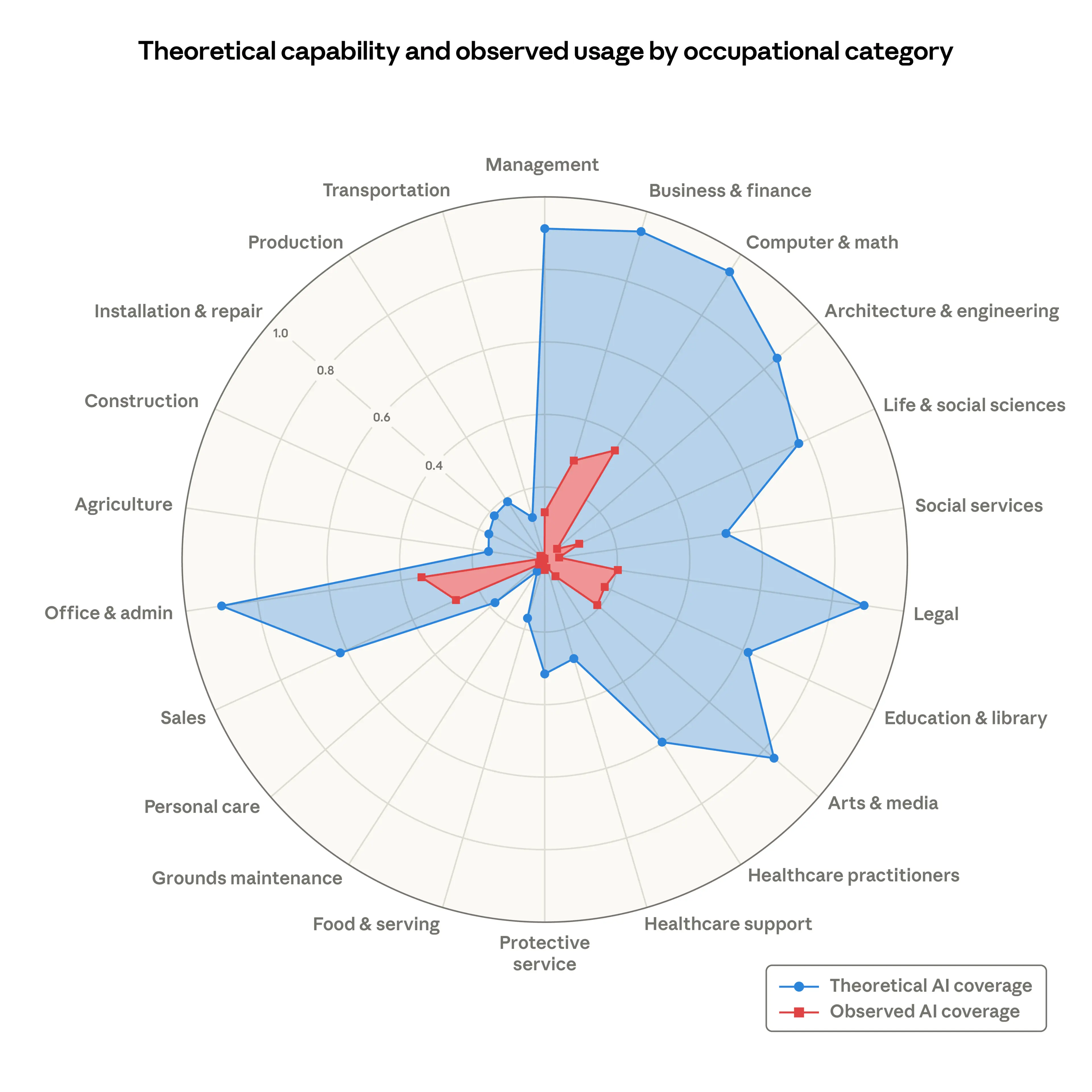
The gap between what AI can do and what most companies are doing has nothing to do with tools, budgets, or readiness. It has everything to do with courage.
Most companies are not failing at AI. They are succeeding at avoidance and calling it strategy.
The evidence isn’t subtle. AI can now write code, analyze contracts, predict demand, run customer support, generate campaigns, and compress weeks of analysis into hours. The tools exist. The case studies exist. The ROI exists. And yet, most organizations are stuck: in workshops that lead to pilots, in pilots that lead to reports, and in reports that lead to more workshops.
This is not an information problem. Every executive reading this already knows AI is important. They have read the articles, attended the conferences, and sat through the vendor demos.
The real problem is that knowing something is important is not the same as being willing to change because of it.
“AI adoption is not stalling because organizations lack capability. It is stalling because they lack the courage to stop protecting how work currently happens.”
Here is what that actually looks like in practice: six ways organizations disguise avoidance as diligence.
01 — The Literacy Excuse “We Don’t Understand It Yet.”
This is the polite version of delay. Leaders frame their hesitation as a knowledge gap, as if a complete understanding of AI were a prerequisite for acting on it. It never was. You did not wait to fully understand the internet before building a website. You did not master cloud infrastructure before migrating to it.
The organizations winning with AI right now do not have more information. They have more tolerance for learning while doing.
What’s Actually Happening: Teams are waiting for certainty before they experiment. Training is scheduled as a future event rather than treated as the experiment itself.
What Moves the Needle: Build role-specific AI literacy through real work, not seminars. The person who learns fastest is the person who starts first.
02 — The ROI Trap “Show Me the Payback First.”
ROI frameworks were built for predictable investments. AI is not a predictable investment; it is a capability multiplier whose value compounds over time, and faster for those who start earlier.
Demanding proof before experimentation is not financial discipline. It is a way of making inaction feel responsible.
The companies that will dominate their categories in five years are not the ones who waited for ironclad case studies. They are the ones building proprietary data loops right now, while competitors debate spreadsheets.
What’s Actually Happening: Organizations are applying capital-allocation logic to competitive positioning decisions. These are not the same thing.
What Moves the Needle: Run 30–60 day pilots that measure speed, quality, and decision velocity, not just cost. AI ROI shows up first in things that don’t fit neatly on a spreadsheet.
03 — The Tool Avalanche “Buying Tools Instead of Redesigning Work.”
There are now hundreds of AI tools, and organizations are drowning in them. Most companies respond to this by buying more of them, adding them to existing workflows, and waiting for the transformation to occur.
It never does. Adding AI to a broken process does not fix the process. It accelerates it.
Stop asking “which tool should we use?” Start asking, “Which decision or task should no longer exist?”
AI-native companies do not start with tools. They start with a first-principles question: if we were building this operation from scratch today, with AI available from day one, what would it look like? The answer is almost never “same as now, but with a chatbot.”
04 — The Real Resistance “It Is Not About the Technology.”
When someone says “I’m not sure AI is ready,” they usually mean “I’m not sure I am ready.” The resistance is not technical. It is personal, about status, identity, and the discomfort of being a beginner again.
Middle managers resist because AI exposes the layers of process around which they built their authority. Senior leaders resist because admitting uncertainty conflicts with the image of competence they are paid to project. Teams resist because they fear being seen as replaceable.
None of this is shameful. All of it is human. But mistaking human discomfort for strategic caution is how organizations lose their window.
What’s Actually Happening: Fear of irrelevance is being laundered as risk management. The conversation stays technical to avoid becoming personal.
What Moves the Needle: Name the real fear openly. Position AI as capacity expansion, not replacement. Start with assistive use cases before autonomous ones. Make it safe for beginners.
05 — The Legacy Lock “Attaching Jet Engines to Bicycles.”
You cannot bolt AI onto legacy operations and expect transformation. The workflow structures, approval layers, reporting chains, and information flows that most organizations run on were designed for a world where intelligence was expensive and human attention was the bottleneck.
AI does not fix that. It reveals how outdated it is, loudly, immediately, and expensively.
Reinvention requires a different kind of discipline: the willingness to ask whether entire categories of work should exist at all. That question makes people uncomfortable. It should. That discomfort is the feeling of actual transformation, not just transformation theater.
06 — The Ownership Void “When It Is Everyone’s Job, It Is Nobody’s Job.”
AI sits awkwardly between IT, operations, innovation, and strategy, making it a shared responsibility no one actually owns. The result is an endless loop of pilots that generate reports that recommend more pilots.
Organizations do not fail at AI because they lack talent or budget. They fail because they lack someone with the mandate and authority to make uncomfortable decisions and see them through inevitable friction.
→ Assign a single accountable AI owner with real authority, not just a title
→ Build a small, cross-functional task force with a mandate to remove friction
→ Measure them on outcomes, not on activity or compliance
→ Give them permission to kill legacy processes, not just manage them
AI adoption dies in committees. Every month without an owner is a month of compounding competitive disadvantage, running silently in the background while you debate governance structures.
The Companies That Win Will Not Be the Most Technical.
They will be the ones who moved before they felt ready. Who experimented before the ROI was guaranteed? Who redesigned how work happens instead of protecting what already exists.
AI is no longer a technology problem. The technology works. It works remarkably well, right now, for organizations willing to build their strategy around it rather than tack it on.
What remains is the harder work: the cultural change, the organizational courage, and the willingness to make decisions in the face of uncertainty rather than use uncertainty as an excuse not to decide.
The adoption gap is real. And every day it stays open, it widens because AI does not wait, and your competitors who are already experimenting are compounding the advantages you have not yet started building.
The question was never whether AI works. The question is whether you are willing to change before you are forced to.
Stop Waiting. Start Somewhere.
The organizations transforming right now did not start with a perfect strategy. They started with a real experiment and iterated from there. The only thing standing between where you are and where you need to be is the decision to begin.