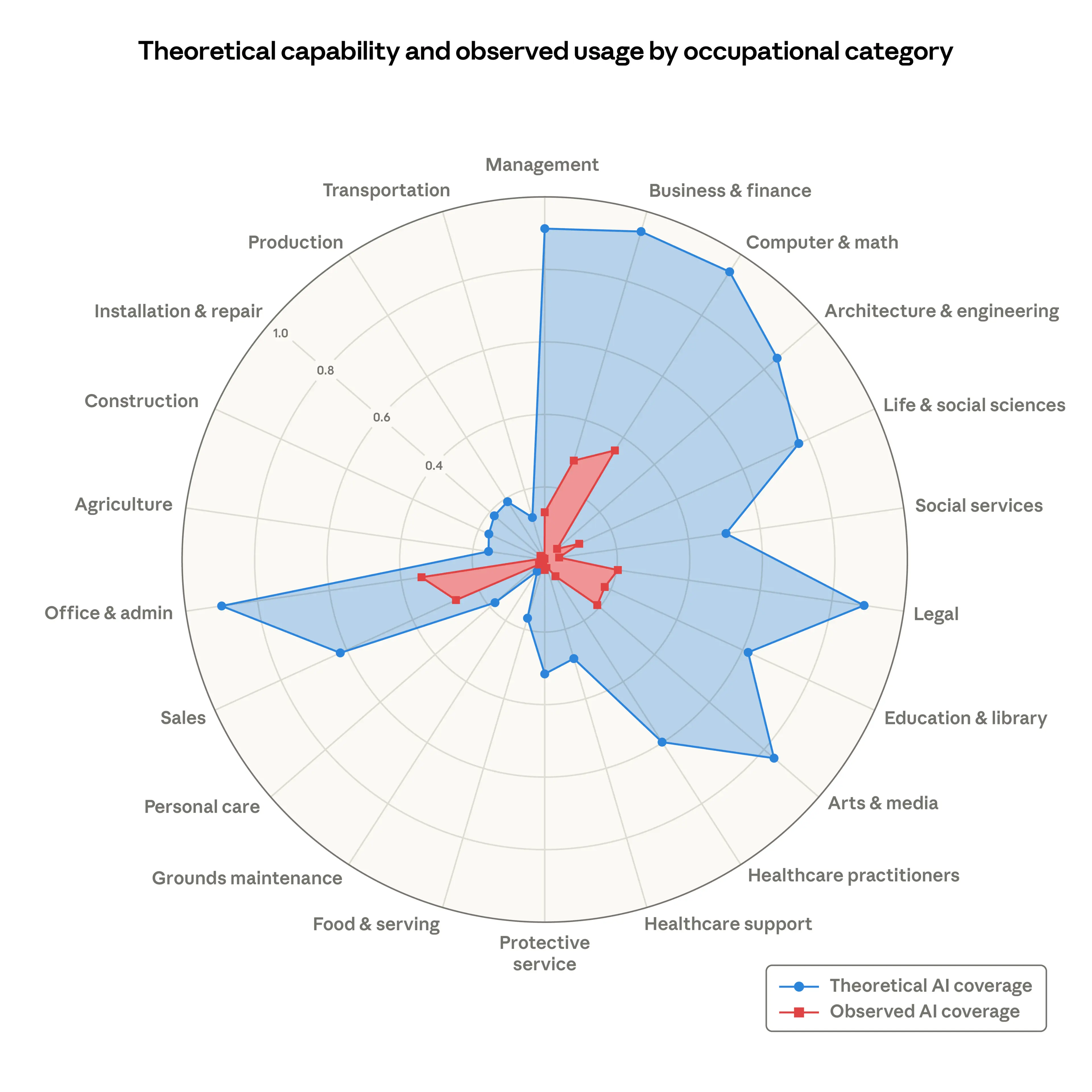
As of this moment, AI is not responsible for mass job displacement. It is somewhat responsible for hiring freezes and headcount reduction. They are two different things, but people feel it. A recent report by Anthropic on the labor-market impact of AI featured an image that generated significant buzz.
It shows the most exposed occupations and their theoretical vs observed AI coverage.
The image also shows that AI is far from reaching its theoretical capabilities.

Still, the question is worth asking: Will job displacement take decades?
The honest answer is: probably yes. But “slow” isn’t the same as “safe,” and that distinction matters more than most business leaders realize.
The Task vs. Job Distinction
Start with what economists call task-level automation. A job isn’t a single thing; it’s a bundle of tasks. An accountant collects data, reconciles accounts, checks compliance, communicates with clients, exercises judgment on edge cases, and advises on tax strategy. AI might automate the first three. The role persists because the remaining tasks still matter.
This is how technology has always worked. Spreadsheets didn’t eliminate accountants. CAD didn’t eliminate engineers. Excel didn’t eliminate financial analysts. They changed the job’s composition, not its existence.
But here’s the caveat that often gets buried: automating 40–60% of a role’s tasks doesn’t reduce the number of jobs; it reduces the number of people needed to do them. A firm with 10 analysts doesn’t eliminate the analysis function; it keeps 4 and calls it an efficiency gain. The job category survives. The headcount doesn’t.
The Headcount Problem
This is where the “jobs won’t disappear” argument quietly falls apart. Displacement doesn’t show up first in unemployment data. It shows up in hiring freezes. Roles that go unfilled. Teams that don’t get backfilled when someone leaves. Entry-level positions that quietly stop being posted.
The job title exists. The opening doesn’t.
This compression is already happening in junior copywriting, entry-level coding, paralegal research, and basic customer support. Watch the hiring trends in these categories, not the layoff announcements.
Adoption Is the Real Bottleneck
Even so, the speed of this compression is constrained by something AI can’t fix: organizational inertia.
Large organizations don’t move fast. To actually deploy AI, they have to redesign workflows, retrain staff, restructure incentives, integrate systems, manage compliance, and survive internal politics. Cloud computing launched in the mid-2000s. In 2024, major enterprises were still in the process of migrating.
AI will face the same drag. The capability gap, what AI can do versus what companies have actually deployed, is vast. An AI model may perform a task at superhuman levels, but until it’s integrated, governed, monitored, and liability-managed inside a specific organization, that capability doesn’t translate into economic impact.
The real bottleneck isn’t AI. It’s the humans who have to reorganize around it.
Why This Time Is Different
That said, two properties of AI separate it from prior automation waves in ways that deserve serious attention.
Previous automation targeted physical labor. AI targets cognitive work: analysis, writing, coding, design, and customer support.
That’s not an economic niche. That’s most of it.
And unlike industrial machines, software scales instantly. Factories took decades to spread globally. ChatGPT reached 100 million users in two months. Once a workflow works, it can propagate across industries almost overnight.
The inertia is real. But so is the reach.
The Most Likely Scenario
What actually plays out probably looks like this:
Right now, AI augments human work. Developers use copilots, marketers use AI writing tools, and analysts use AI research assistants. Productivity improves. Headcount stays roughly stable.
Over the next five years, role compression accelerates. One marketer does the work of three. One analyst manages what a small team used to handle. One support agent supervises multiple AI agents. Companies don’t lay people off en masse; they just stop hiring at the same rate.
Over the next 10 to 20 years, organizations will restructure around AI-first workflows. This is when structural displacement becomes visible at scale, and when the policy, education, and labor systems have to reckon with what’s already been quietly accumulating.
The timeline above assumes continued incremental progress. The leaders building these systems believe something more discontinuous is on the horizon. If they’re right, the window to adapt isn’t a decade; it’s now.
The Window Is Open — But Not Indefinitely
AI won’t destroy jobs overnight. The timeline is real.
But slow displacement doesn’t mean predictable displacement. The firms dragging their feet aren’t buying time — they’re accumulating risk. At some point, a competitor forces their hand, and what looked like a gradual transition becomes a sudden correction.
The window to adapt is open. The question is whether you’re using it or mistaking it for permission to wait.


